Your first evening in Starlane: a beginner's guide
· The Starlane team · 7 min read
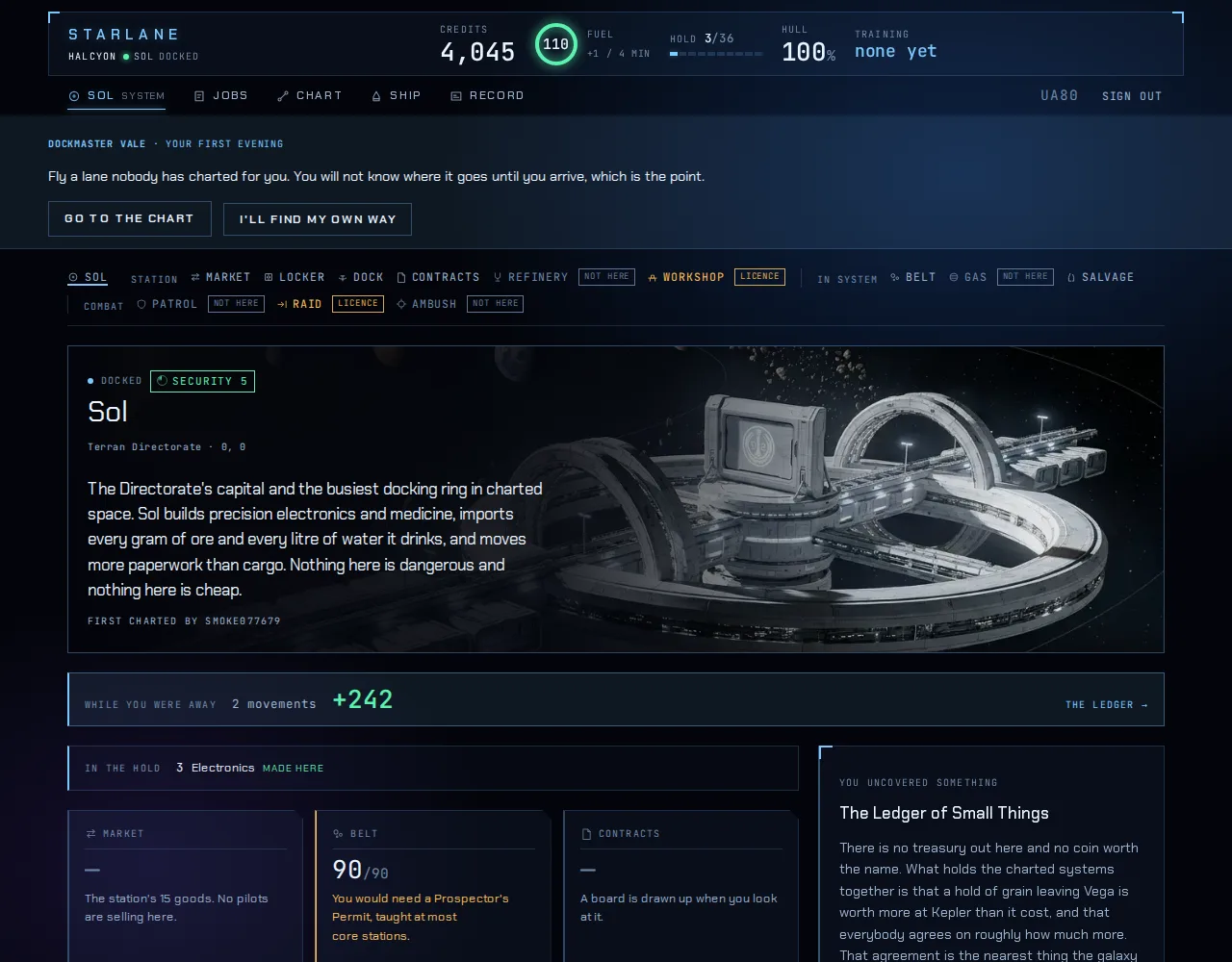
Starlane is a space game you play in a browser tab. There is one persistent universe and one character per account, and nobody hands you a map. Your first evening has a shape, though, and the game walks you through it in six steps. This guide is those six steps, plus the things we wish someone had told us.
1. Pick who you were
Your origin is the one choice you can't take back: one character per account, and no reset. It decides where you wake up, what you're already good at, and who already knows your name. There are five:
- Dock Rat. You grew up loading other people's cargo on Sol's freight decks. You start with hauling skill and a freight licence, in the safest space there is.
- Belt Prospector. Raised in the asteroid belts. You start with prospecting skill and a mining permit, and you read a rock face better than a market.
- Navy Washout. Two years of flight training and no commission at the end of it. You start with gunnery and a Reserve Commission, which pays half a posted bounty, and the Directorate still returns your calls.
- Company Courier. You ran documents for the League. You start with navigation and a freight licence, and the League remembers you kindly.
- Fringe Smuggler. The most money and the best margins, but you start in lawless space, where other pilots can attack you. It trades safety for tempo.

None of them is the strong pick. Choose the life you want to play, not the numbers. You also choose a face, and there's a wide range of people out here to choose from: humans, synthetics, and two other peoples who work the same ports.
Nobody starts with a ship. That comes after the dock.
Before the dock: the night the Tern is lost
You don't start on the dock. You start as crew on a hauler called the Tern, on the rim, on a bad night: the power board needs rerouting, a hail comes in enciphered, and a raider comes out of the dark. Each is a real board from the game, and each beat feeds the next: leave the comms clean power and you get longer to read the hail; read all of it and your gunner gets a called shot.
You'll lose the ship anyway. That's the story. It takes about five minutes, it gives you nothing and takes nothing, and you can skip it after the first beat. Then you wake on your origin's dock.
2. Work a shift on the dock
Before you fly anywhere, earn something. The dock board posts shifts, and almost all of them need no ship. Take a cargo shift first: your first one takes a couple of minutes whatever the board says, and it pays what it posts.
A shift is a small puzzle: you stow a freighter's hold for a voyage of three calls. Put each crate where it won't have to be dug out at an earlier port, and the shift runs shorter. The pay never changes. Your first shift has two stowage rules: discharge order, and nothing on a fragile crate. Each of your next four cargo shifts adds one more (weight, trim, cold cargo, hazardous goods), and the game announces each new rule on the shift that brings it. You can always take the standard stow and skip the puzzle, at the posted time.
Every job in Starlane works like this: a plan you make before the clock starts, with a best answer worth getting close to.
This is also where you learn the game's rhythm: things take real time, and they keep going while you're away. Start a shift, read something, come back.
Then take the dockmaster's Skiff
To trade or to fly you need a hull. The dockmaster offers every new pilot a fuelled Skiff on credit. The offer is on the Dock screen, with what it costs, and nothing is owed until you press Take the Skiff on credit. The price includes two weeks of insurance on the ship, so you're covered while you learn. You can buy a hull at the yard with your wages instead, if you'd rather owe nobody.
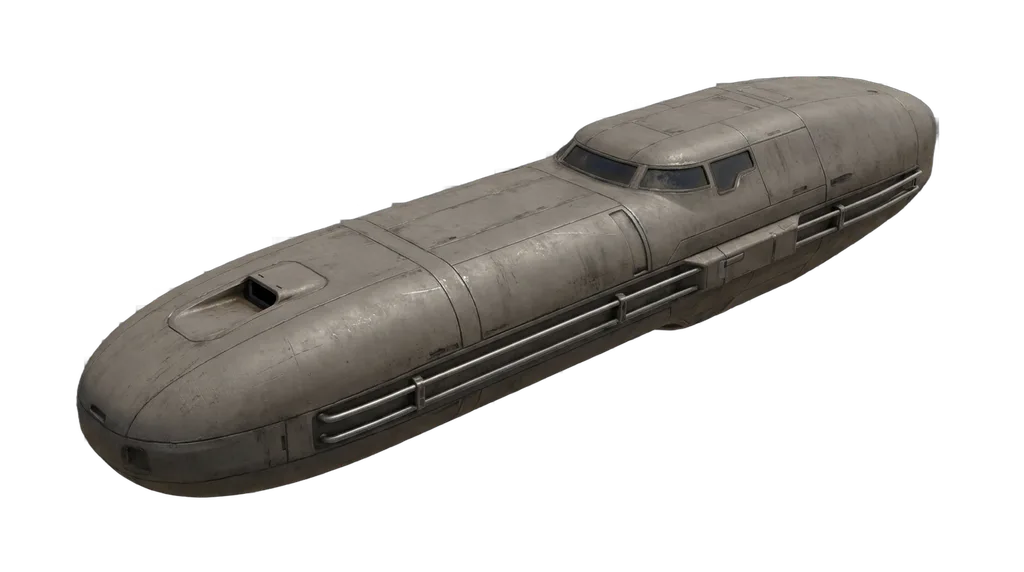
Once you have a ship, its HUD has small games to play while a job runs. They pay bonuses, such as fuel or a faster recharge, never credits.
3. Make your first trade
Buy something where it's made and sell it where it's wanted. It's the oldest living out here, and the quickest way to pay off that Skiff. Prices move as pilots buy and sell, and drift back over time, so a market isn't a fixed table to memorise: it's a place you read.
Two habits help:
- Keep some credits back. A pilot with an empty wallet can't take the next opportunity.
- Raw goods first. A Skiff's hold full of a cheap raw good is a safe first run. Expensive cargo is a lesson you can afford later.

4. Fly a lane nobody charted for you
This is the part people remember. You don't have a map. Each lane out of a system goes somewhere, and you won't know where until you arrive. When you do, it's yours: your chart grows one jump at a time, and your first arrival anywhere pays a small charting fee. If you're the first pilot ever to reach a system, the record says so permanently.
Before every jump you can see the distance, the fuel and the flight time. Then press Survey and go, or Plot the burn yourself along the lane between the two stars first. A good plot saves fuel; skipping it never costs you more than the posted amount. What you can't see is what's on the other side.
5. Own your ship outright
While you owe the dockmaster, half of everything you earn goes to paying him back, automatically, and it never takes you below a little working money. When you have the rest, settle it on the Ship screen and the hull is yours. This step pays you 250 credits when it's done.
Two things to know. You only get that loan once. And the debt survives the ship, so look after it. The Skiff's insurance runs for two weeks; after that, renewing it is worth doing before you take risks.
6. Earn your next licence
Your origin handed you your first licence. The next one you choose and pay for yourself, at an academy: freight, the belt, the bench, the bounty board, or the rim. Any licence you pay for counts, each one opens a line of work of its own, and this step pays 650 credits.
Here is Starlane's most important rule, and it's worth understanding on day one:
- Skills are time. They train on a real-world clock while you're away, one at a time, and nothing can buy them faster.
- Licences are credits plus skill. You pay for a certification, but only once your skills are high enough.
So the pilot who plays an hour a day and the pilot who plays all weekend progress differently, but neither can buy their way past the other.
Meet the other pilots
You're not alone at the station. At a policed station, the register names the pilots in dock with you, each with the face they chose. Tap a name to hail them with one of six friendly lines, such as Fly safe. or Trading, if you're buying. There's nothing to type, so nothing anyone sends can spoil your evening. A hail you receive can be answered, and the station's hails panel shows both sides of every exchange.
When you find people you like flying with, start a crew: two to five pilots who invite each other. A crew has its own board for notes, and a crewmate docked with you can fly escort on your next jump.
If you want to show off what you've done, you can turn on a public page from your account. It's off until you choose otherwise, and it never appears in search engines. Here's how it works.
After the first evening
Finishing the six steps opens your career's own story, offered by somebody you'll meet out there. It pays as you go and points you at the next rung of your career. Where it goes after that is yours to find out.
Once you've earned your first wage, the station shows a While you are away panel. Look at it before you log off: it says what will be different when you come back, such as a skill finishing its training, tomorrow's event in the galaxy, or a fresh set of objectives. Your character never resets. What you build tonight is still there next year.
Read next: why nothing in Starlane can be bought with money.
Ready? Create a pilot. It's free, and there's nothing to download.
Starlane is a persistent space game you play in a browser — free, no download. Start flying →