No pay-to-win, enforced by the architecture rather than a promise
· The Starlane team · 3 min read
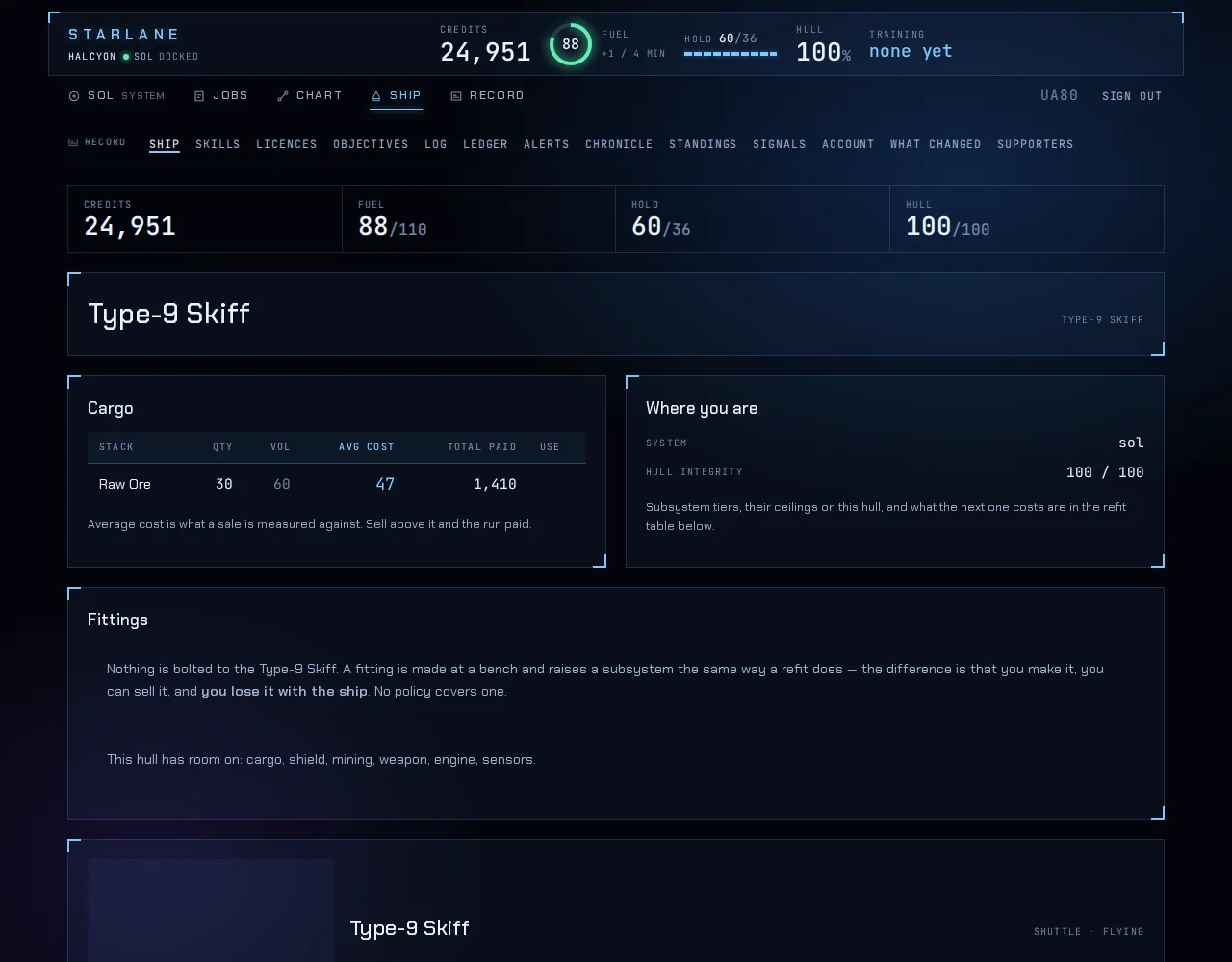
"No pay-to-win" is the most common promise in free-to-play games, and the least checkable. It usually means a policy: a sentence in a design document, a principle the team agrees on. Policies erode. One season a booster sells well, the next a time-saver looks harmless, and the promise quietly becomes "not much pay-to-win".
Starlane makes the same promise, and then makes it hard to break by accident. Here's how.
What's for sale, and what isn't
Starlane costs money to run and carries no advertising. Supporters pay for it, with a one-time purchase or a small monthly one. The two options give exactly the same benefits, and there is no higher tier.
What supporting buys: cosmetics, and a better view of your own history.
What it can never buy: anything that decides an outcome. Careers, skills, certifications, cargo, fuel, ships, and the result of every trade, jump and fight are bought with in-game credits and in-game time only. Skills train on a real-world clock that nothing speeds up. Certifications cost credits and skill levels, so neither money nor patience alone gets you one.
There is no higher tier because there's nothing left to sell. Everything we could add to a pricier tier would affect gameplay, so we don't.
The architecture: the game can't see your wallet
Starlane isn't one program. It's a set of small, separate services, each owning its own part of the world. One runs the universe: pilots, ships, markets, travel, combat. A different one holds accounts: your login, your email, and whether you're a supporter.
The service that runs the game doesn't contain the code that reads supporter status. It isn't switched off or hidden behind a check; it was never put there. Every question the game answers ("did this trade go through?", "who won this fight?", "can this pilot fly this ship?") is answered by code that has no way to ask whether you paid.
So "no pay-to-win" isn't a rule our programmers have to remember. To break it, someone would have to deliberately move the supporter record into the part of the system that runs the game. That's a visible, reviewable change, not a quiet tweak.
And a test fails if anyone tries
Every change to Starlane runs through an automated check that inspects what each service is built from. It asserts, in both directions, that the services deciding gameplay don't include the one holding supporter status. If a change ever wired the two together, the check fails and the change can't ship until someone has argued for it in the open.
That's the difference between a promise and a property. A promise is kept by people remembering it. A property is kept by the system refusing to build without it.
Why go this far?
Because the alternative goes the same way every time. Pay-to-win rarely arrives as a decision; it arrives as a dozen small, individually reasonable additions. A rule nobody can quietly bend is the only kind that survives a game's tenth year.
It also changes how the game feels to play. When you see another pilot with a better ship, a rarer licence or a fuller hold, you know they earned it. The only things a supporter has that you don't are a badge and a clearer view of their own past.
Supporting, if you want to
If Starlane earns a place in your evenings and you want to help keep it running, the supporters page explains what it costs and who's paying for it. You'll only be named there if you choose to be, and any payment is refunded on request within 14 days.
And if you never pay a cent, you're playing exactly the same game as everyone else. That's the point.
Start playing for free, or read your first evening in Starlane.
Starlane is a persistent space game you play in a browser — free, no download. Start flying →