Real physics in a space game: the laws under every job in Starlane
· The Starlane team · 8 min read
Every job in Starlane comes with a plan you work out yourself: how to stow a hold, where to cut a wreck, when to fire the furnace. For a while, the numbers behind those plans were invented. A rule said a keel costs two, or a tank adds a little time, and you learned the rule.
Now the plans are the physics. A wreck costs the seconds a plasma torch needs to burn through its steel. A sensor sees a hull by the radar equation. A jump's fuel follows the rocket equation. This article goes through what is real, and where the line is drawn between that and the fiction.
Why bother
Most jobs play about as hard as they did, and what a perfect plan is worth didn't move in any of them. The economy was measured against those numbers, and they stayed.
What changed is why the numbers are what they are. A made-up rule has to be memorised. A law can be reasoned about. Once you know a keel is four times thicker than the skin, you don't need to be told it takes four times as long to cut. Physics is also strict where a made-up rule never is. One old rule said two capacitors side by side would arc, which nothing about a capacitor makes them do. Another made a gravity well cheaper to cross than open space.
Salvage: a plasma torch's energy balance
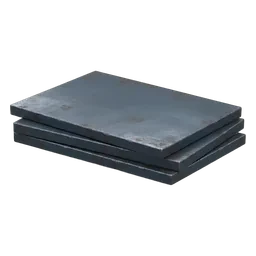
A wreck is a board of plates, and the torch cuts its way across it. Each cell costs the seconds the arc takes to melt its way through. The arc delivers 20 kW, a little over half of which goes into the steel. The heat it takes to melt a 3 mm slot through the steel grows with the steel's thickness, so the cut slows in proportion. Through ordinary 10 mm skin that's 3.2 metres a minute, about what a real industrial plasma cutter does.
So the skin takes 75 seconds a cell, a frame's thicker web two and a half times that, and the keel four times. A fuel tank has to be vented before the torch touches it. Venting is a real blowdown: residual vapour escaping through a small hole into vacuum, the pressure falling off exponentially until it's safe. That takes about six minutes, and a route through a tank shows it in the job's time.
Mining: the rig bay, in watts
Before a cut, you can lay out your rig bay: a focusing lens, a coolant coil, a capacitor, a sonic tap, a beam splitter and a damper shim. Its score is now the laser power it adds at the rock, in watts, and every number comes from something real:
- The rock. Each rock type is a real rock with its own behaviour. Granite spalls under pulsed heat and cracks under ultrasound. Basalt is dark, so it soaks up the beam, but it barely cracks: it has to be melted. Hydrothermal rock arrives already hot. Serpentinite's fibres tear rather than crack, and they turn ultrasound into heat.
- Heat. Most parts dump heat into the cold plate they sit on, and a warm part works worse. A warm lens is a weaker lens. Heat flows between neighbours by conduction, so a part next to a hotter one suffers, and a part next to a cooler one gains. Two identical parts side by side exchange nothing, because nothing crosses an edge between two equal temperatures.
- The bus and the shake. A sonic tap is driven by the capacitor's pulses, so the two work together when they're next to each other. The tap also shakes nearby optics out of alignment, unless a damper sits beside it.
The refinery: Newton's law of cooling
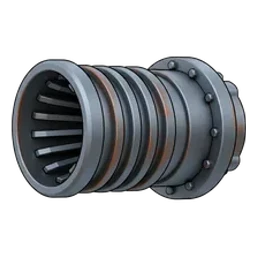
A furnace program is a list of commands: heat, warm, hold, cool, and on harder cards, purge. The charge follows Newton's law. Each command closes part of the gap between the metal's temperature and the fire's, so the heat always lags behind what you asked for. A hot fire aimed at a narrow window sails straight through it. Planning for the lag is the puzzle, and a good program finishes sooner. The metal you get is the same either way.
Gas skimming: the atmosphere's own laws
A gas giant's decks run from thin haze to air at twelve times Earth's sea-level pressure, and each deck now behaves as that air would:
- the gas you scoop goes with the density;
- the shield's heat on the way through follows the law re-entry engineers use, rising with the square root of density;
- drag brakes your orbit in proportion to density;
- a higher orbit is a longer coast, so it sheds more heat.
The old tables had one deck with a hundred and twenty times the pressure of another giving eleven times the gas. Under the ideal gas law it's over thirty times.
The jump: delta-v and the rocket equation
Plotting a course across a lane is a problem in delta-v. Coasting is free, in open space or past a gravity well. Changing course costs, because starting a sideways drift and stopping it again both take a burn.
A slingshot past a moving body can gain you speed or lose it, depending on which side you pass. Behind it, you're carried along. In front, you're braked. The fuel you spend follows the rocket equation, so each unit of burn over the best course costs slightly less fuel than the one before.
The stow plan: a ship heels
Loading a hold used to mean keeping port and starboard close in tonnes. A real ship doesn't care about tonnes. It cares about the moment: each crate tips her by its weight times its distance from the centreline. A crate in an outer bay counts three times one in an inner bay.
How far she may heel depends on how loaded she is. A lighter ship heels further for the same moment, so the allowance tightens after every port of call. Past the limit, you pump ballast, and ballast costs you time.
Combat: real gunnery
A hostile's guns fire rounds, and a round hits if its aiming error puts it inside your hull. That's the Rayleigh distribution, the textbook model for shots scattered around an aim point. Knock out its fire control and its aim spreads to twice the width. Its guns don't fall silent; most of what they fire just goes wide. When a hostile closes in, every gun it still has gets more accurate, because an angular error makes a smaller miss at shorter range.
The raid: the radar law
A raider plots an approach to a convoy's lane, and everything with a sensor is looking for them. What each sensor sees of a hull falls with the fourth power of range: twice as far away, a sixteenth of the echo. Dust and debris hide a hull. The old table kept about a third of the echo for every cell further out, which nobody's radar does.
Research: real chemistry
An assay looks for the conditions that give the best yield. Each condition drives two reactions in a row: the product you want forms, then degrades if you push too far. So a step short of the best reads differently from a step past it, which tells you which way to go. The catalyst follows a "volcano": bind too weakly and nothing sticks, too strongly and nothing lets go. Temperatures are spaced so that every step speeds the reaction by the same factor, as Arrhenius says they should.
Docking: orbital mechanics
After a jump, you can fly your own approach to the station. Close to a station, the real equations of orbital rendezvous apply, and they're the opposite of what you expect. Thrust forward and you rise into a higher, slower orbit and fall behind. Thrust down and you drop into a faster one that carries you ahead. A good approach makes your next departure from that station quicker.
The HUD: a reactor, a radio, air and a breaker
The small games on your ship's displays are physical too:
- The reactor. The control rods stay where you set them. Pull them out and the power jumps, then keeps climbing until you put them back, which is how a real reactor behaves. A predictor shows where the needle will land.
- The comms decode. A hail crosses a real radio link. A caller far away arrives weak, and some letters come through changed.
- The breach drill. Air obeys the gas laws. A hole empties a small airlock in a minute and a big cargo bay over several, so sealing a hatch is a real choice.
- Bus Tie. A breaker heats as the square of the current and cools when relieved. A small surge rides through, and a motor's start-up surge doesn't.
- The scan. It's a radar, and a contact's echo falls with the fourth power of its range.
Where the fiction is
Some of it has to be fiction, and we'd rather say where than hide it.
The jump itself is the fiction. A lane between stars is crossed in minutes, which is about a million times the speed of light or more. No physics allows that. The flight deck prints the multiple instead of pretending otherwise. What you see on the way is real: how bright each star is from where you are, and how old its light is.
The size of things is sometimes tuned. A law sets the shape of a table, and one number sets its scale so it fits a game. The breach drill's holes are a fist and a forearm, and a turn is a minute. The dust a jump burns fuel to push through is real in its shape, but not in its strength on a lane crossed faster than light. Where a number is tuned, it's tuned against a limit the game already had, never to make a result look better.
How we keep it honest
Each law is checked twice. The code that runs it is tested against the same law written out again a different way. For example, the torch is tested by working the energy balance from the other end. The tests also keep the old made-up rules and show the new laws rejecting them. A check that has never failed on a wrong answer proves nothing.
New to Starlane? Start with your first evening. If the rig bay is what caught your eye, the belt prospector's guide walks the whole mining loop.
Create a pilot. It's free, and the physics is the same for everyone.
Starlane is a persistent space game you play in a browser — free, no download. Start flying →